



During menopause, significant biological changes occur that can influence cardiovascular health. Do you know what they are? And have you ever wondered if we could learn the trick that plants use to generate energy? These and other questions will be addressed by researchers from the four research centers in the region and the Rovira i Virgili University (URV) next Monday, September 21 at the Castell del Cambrer in Reus, starting at 6 p.m.
All of this will take place during another edition of the ‘Research for Change’ micro-talks, one of the previous events for the European Research Night in 2026. This session of short interventions is organized by the Institute for Biomedical Research in Southern Catalonia (IRB CatSud) in collaboration with the URV and the Reus City Council. The speakers who will participate in the meeting represent the research centers IRB CatSud, ICIQ, IPHES and ICAC, and there will also be some from the URV.
Cardiovascular health, nutrition, microbiota, nanoscience, archaeology and heritage will be the main topics of this year’s interventions. The talks, lasting around 10 minutes, have an agile format, and the speakers use plain, informative and accessible language. This approach gives the event a close, relaxed and participatory character, as the audience is encouraged to intervene, share opinions and ask questions.
The objective of the meeting is for the different participating research centers to bring the science they develop closer to the public, making their studies and projects known in a way that is more understandable and accessible to everyone.
The speakers and topics of the talks will be the following:
1. Menopause and cardiovascular health: understanding the changes to gain health – Olivia Burton (IRB CatSud).
2. The diet that made us human – Marina Lozano Ruiz (IPHES-CERCA).
3. Reinventing photosynthesis with nanoscience – Carla Casadevall Serrano (URV, ICIQ).
4. Seeds that explain landscapes: agriculture and daily life in ancient Greece – Marina Daniel Pena (ICAC).
5. The uses of memory and heritage: the heritage management of Francoist monuments – Berta Pla Romero (URV).
6. An archaeologist sifting through the trash – Maria Joana Gabucio Vilarrasa (URV).
7. Metabolites, microbiota and circadian rhythms: the three vertices of a vicious circle that promotes health (or disease) – Aleix Ribas Latre (IRB CatSud).
European Research Night events
The European Research Night is an informative initiative that has its central activity with the scientific workshop fair, which will take place in Plaça Corsini in Tarragona on the afternoon of Friday 25 and the morning of Saturday 26 September . Between the two days, 50 workshops will make available to attendees highly experimental proposals from different fields of knowledge, to bring science, in its variety of disciplines, closer to young and old in a fun and accessible way.
The European Research Night is a public scientific dissemination event that takes place simultaneously every year in 300 cities in 30 countries on the European continent. Since 2018, the URV has been organizing this initiative in the Tarragona region, which has been growing and consolidating over the past nine years and which in the previous edition had the participation of thousands of people throughout the region. The aim of the European Research Night is to bring research and its protagonists closer to audiences of all ages and to publicize research and innovation in plain and understandable language.
Detailed information with all the activities of the European Research Night can be consulted on the website tarragona.nitdelarecerca.cat
This action is part of a series of meetings that the Departament is carrying out in CERCA centres, with the aim of learning about their situation first-hand
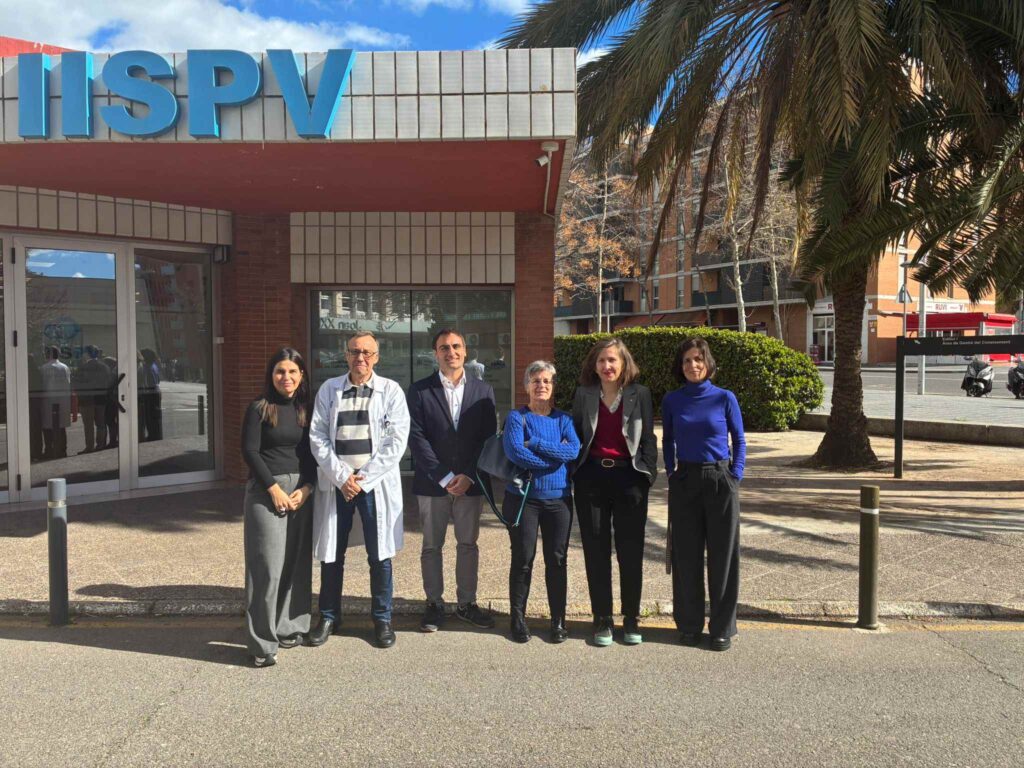
The Direcció General de Recerca (DGR) of the Govern de Catalunya has recently announced the start of a series of institutional visits to research centres across the region. One of the first visits in the area took place at the Southern Catalonia Institute of Biomedical Research (IRB CatSud, formerly IISPV). The meeting was held last Tuesday, 17 February, at the Institute’s headquarters in Tarragona.
The visit was attended by the Direcció General de Recerca, Teresa Sanchis, and the General Deputy of Recerca, Eva Pérez. Representing the Institute were the director, Joan Vendrell; the deputy director, Elisabet Vilella; the manager, Francesc López; and the head of the technical office, Elisabet Galve.
This action is part of a broader initiative aimed at strengthening direct knowledge of CERCA centres and of the different actors in the Catalan research system. The purpose of these meetings is to understand, directly and from the department’s perspective, the reality, needs, and strategic lines of each centre, with the intention of reinforcing institutional collaboration and improving public policies that support research.
For IRB CatSud, this visit is an opportunity to show the centre’s impact on the research ecosystem of Camp de Tarragona and Terres de l’Ebre, as well as to highlight its projects and research team.