



A study concludes that environmental contaminants capable of altering the hormonal system, also known as endocrine disruptors, do not affect the immune system equally. In fact, they can reduce the viability of immune cells and even modify the signals that activate inflammation. These chemical substances are present in numerous everyday objects, such as food packaging and textiles, furniture and even industrial products. A study led by the Southern Catalonia Biomedical Research Institute – IRB CatSud, entitled Immunomodulatory effects of Bisphenol A, perfluorooctanoic acid, and tris(1,3-dichloro-2-propyl) phosphate on THP-1-derived macrophages, published in the scientific journal Environment International, analysed the effect of three environmental contaminants, bisphenol A (BPA), tris(1,3-dichloro-2-propyl) phosphate (TDCPP) and perfluorooctanoic acid (PFOA), and their effect on cells of the immune system. The research shows that not all endocrine disruptors affect the organism in the same way, but rather that each one triggers different biological responses.
The results of the study, carried out by the Environmental, Food and Toxicology Technology Center (TecnATox) and Environmental Analysis and Management using Computer Aided Process Engineering (AGACAPE) research groups at IRB CatSud, show specific effects for each of the compounds studied when they encounter cells that are essential in the first line of defense of the immune system (macrophages).
Among the compounds analysed, a substance used to make certain furniture, fabrics and industrial products more fire resistant (TDCPP) was the one that showed the highest toxicity. Exposure to this substance reduced cell viability and caused a decrease in certain immune responses, which points to a possible immunosuppressive effect.
Regarding the chemical compound known as PFOA, present in coatings resistant to water, stains or grease, the researchers observed that it activates the body’s defenses very intensely. However, this activation did not translate into an increase in the levels of key molecules involved in communication between immune cells (cytokines). In other words, the cells appeared to activate certain defence mechanisms, but without generating the full response that the researchers expected to observe. This result points to possible mechanisms of action that are still poorly understood and that will require further investigation.
In contrast, BPA, a compound used in some plastics and food packaging coatings, had almost no effects in the tests. The researchers observed that it neither harmed cell health nor altered our defenses, nor did it prevent cells from communicating with one another. In any case, the research team points out that additional studies will be needed to better understand its impact on the immune system under other experimental conditions.
Overall, the results highlight that compounds classified within the same group of contaminants can have very different effects on immune cells. This knowledge may contribute to improving the assessment of the risks associated with endocrine disruptors and to gaining a better understanding of how environmental exposure influences human health.
Researchers from the Universitat Rovira i Virgili (URV) and from the German Federal Institute in Berlin (Germany) participated in the study. Furthermore, the study is part of the European PARC project (Partnership for the Assessment of Risks from Chemicals), a Horizon Europe initiative and co-funded by the European Union focused on the assessment and management of risks from exposure to chemical substances in order to protect human health and the environment.
Bibliographic reference
Sabuz, O., Blanco, J., Deepika, D., Schuhmacher, M., & Kumar, V. (2026). Immunomodulatory effects of Bisphenol A, perfluorooctanoic acid, and tris(1,3-dichloro-2-propyl) phosphate on THP-1-derived macrophages. Environment International, 213, 110321. https://doi.org/10.1016/j.envint.2026.110321
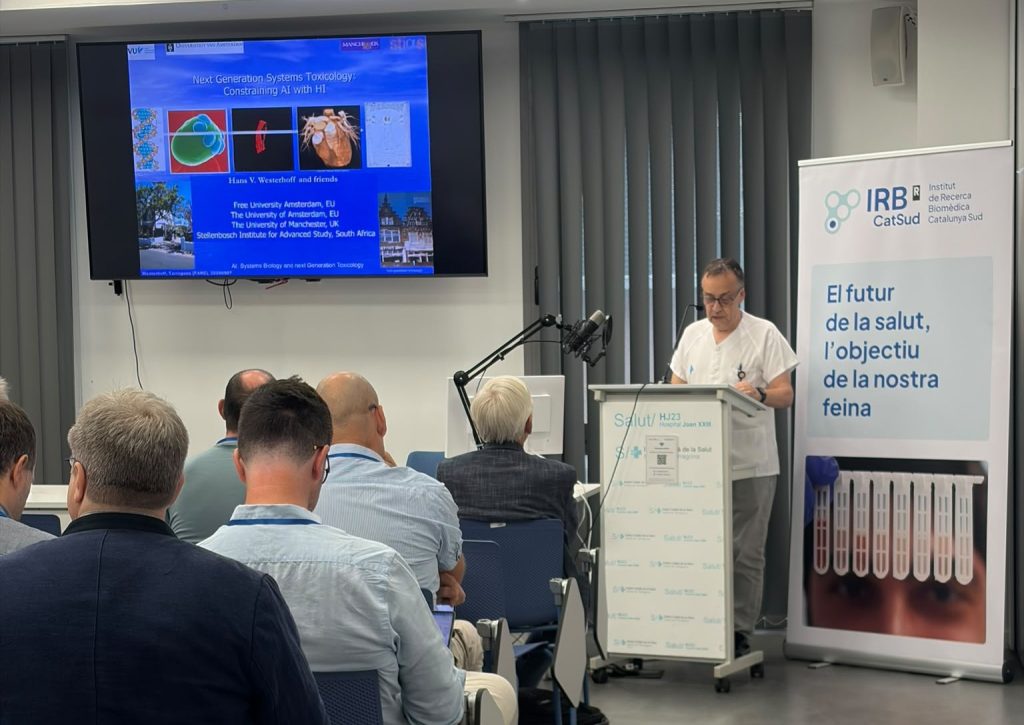
This week, Tarragona is the European headquarters for the protection of health and the environment against the risks caused by products of chemical origin. A hundred scientists, researchers and risk assessors from the European continent are meeting until this Thursday to mark the roadmap for the scientific regulation of the European Union in the field of chemical safety in the coming years. The Institute for Biomedical Research of Catalonia South (IRB CatSud) is leading this meeting with representatives of a total of 200 international organizations. The objective is to accelerate a paradigm shift through the use of artificial intelligence (AI) and cutting-edge technologies, in the assessment of the risks that chemical products pose to health and the environment. Through these new analytical approaches, the scientific community seeks to predict the impact of pollutants on health and the environment in a much faster, more precise, transparent and economically efficient way.
The meeting, which began on Monday, is led by IRB CatSud together with international scientific organizations from Germany (BfR), France (ANSES) and Greece (AUTH). The conference will feature the direct participation of the continent’s top regulatory authorities, including the European Food Safety Authority (EFSA), the European Chemicals Agency (ECHA) and the European Medicines Agency (EMA).
Throughout Monday and Tuesday, presentations and discussions focused on the impact of emerging technologies, with a special emphasis on the use of artificial intelligence language models for the automation of risk assessment. In parallel, specialists participated in an intensive hackathon to develop prototypes of next-generation analytical tools.
This Wednesday, the focus shifted to the annual meeting of the Working Group on Scientific Data Management (WP7), led by the VITO Institute (Belgium), the University of Birmingham (UK) and IRB CatSud, represented by Vikas Kumar and his team. Experts discussed guidelines to ensure that the vast amount of information generated in Europe is fully accessible and interoperable. This will lay the foundations for the future Centre for Chemical Risk Assessment, contributing to the creation of the European Union’s Common Data Platform on Chemicals.
This meeting is held within the framework of the Partnership for the Assessment of Risks from Chemicals (PARC), a €400 million European megaproject, co-financed by the European Union’s Horizon Europe framework program. PARC brings together more than 200 public and academic institutions from nearly 30 countries with the mission of promoting the European Commission’s Sustainability Strategy for Chemicals and advancing towards the zero pollution goal of the European Green Deal.