



During menopause, significant biological changes occur that can influence cardiovascular health. Do you know what they are? And have you ever wondered if we could learn the trick that plants use to generate energy? These and other questions will be addressed by researchers from the four research centers in the region and the Rovira i Virgili University (URV) next Monday, September 21 at the Castell del Cambrer in Reus, starting at 6 p.m.
All of this will take place during another edition of the ‘Research for Change’ micro-talks, one of the previous events for the European Research Night in 2026. This session of short interventions is organized by the Institute for Biomedical Research in Southern Catalonia (IRB CatSud) in collaboration with the URV and the Reus City Council. The speakers who will participate in the meeting represent the research centers IRB CatSud, ICIQ, IPHES and ICAC, and there will also be some from the URV.
Cardiovascular health, nutrition, microbiota, nanoscience, archaeology and heritage will be the main topics of this year’s interventions. The talks, lasting around 10 minutes, have an agile format, and the speakers use plain, informative and accessible language. This approach gives the event a close, relaxed and participatory character, as the audience is encouraged to intervene, share opinions and ask questions.
The objective of the meeting is for the different participating research centers to bring the science they develop closer to the public, making their studies and projects known in a way that is more understandable and accessible to everyone.
The speakers and topics of the talks will be the following:
1. Menopause and cardiovascular health: understanding the changes to gain health – Olivia Burton (IRB CatSud).
2. The diet that made us human – Marina Lozano Ruiz (IPHES-CERCA).
3. Reinventing photosynthesis with nanoscience – Carla Casadevall Serrano (URV, ICIQ).
4. Seeds that explain landscapes: agriculture and daily life in ancient Greece – Marina Daniel Pena (ICAC).
5. The uses of memory and heritage: the heritage management of Francoist monuments – Berta Pla Romero (URV).
6. An archaeologist sifting through the trash – Maria Joana Gabucio Vilarrasa (URV).
7. Metabolites, microbiota and circadian rhythms: the three vertices of a vicious circle that promotes health (or disease) – Aleix Ribas Latre (IRB CatSud).
European Research Night events
The European Research Night is an informative initiative that has its central activity with the scientific workshop fair, which will take place in Plaça Corsini in Tarragona on the afternoon of Friday 25 and the morning of Saturday 26 September . Between the two days, 50 workshops will make available to attendees highly experimental proposals from different fields of knowledge, to bring science, in its variety of disciplines, closer to young and old in a fun and accessible way.
The European Research Night is a public scientific dissemination event that takes place simultaneously every year in 300 cities in 30 countries on the European continent. Since 2018, the URV has been organizing this initiative in the Tarragona region, which has been growing and consolidating over the past nine years and which in the previous edition had the participation of thousands of people throughout the region. The aim of the European Research Night is to bring research and its protagonists closer to audiences of all ages and to publicize research and innovation in plain and understandable language.
Detailed information with all the activities of the European Research Night can be consulted on the website tarragona.nitdelarecerca.cat
Reus, Tarragona and Tortosa will once again host the international science outreach festival Pint of Science, taking place from 18 to 20 May. The event brings cutting-edge research to everyday places such as bars and cafés. Researchers from IRB CatSud take part with short and accessible talks designed to bring science closer to the public.
In Reus, the programme includes a strong representation from the Institute. On Monday 18 May (7 pm), at Gastropub As de Copes, researcher Maite Royo Iglesias will talk about mental health with ‘Més enllà del moment: adversitats i salut mental’. At the same time, at Racó de l’Orfeó Reusenc, Martí Llaurador-Coll will present ‘Sang: l’Amazon del nostre cos’, and IRB CatSud deputy director Elisabet Vilella, together with Josep Gumà, will explain precision medicine from the fields of psychiatry and oncology.
The following day, also in Reus, the programme continues from 7 pm. At As de Copes, Héctor Vázquez Lorente will speak about nutrition and bone health, and Sara Bernardo Castro will present ‘El menú secret del cervell: dieta abans de néixer’. Meanwhile, at Orfeó Reusenc, Bernat Ballvé Gelonch will explore the impact of diet on mental disorders.
In Tarragona, IRB CatSud researchers will also take part. On 18 May (7 pm), at Tòtem Café, Aleix Ribas Latre will give the talk ‘Què és el jet lag social?’, focusing on the difference between biological, social and solar clocks, and how this misalignment affects daily life. On 19 May (7 pm), at the same venue, Iris Ginés Mir will discuss the effects of tobacco, with a focus on how smoke exposure can worsen Crohn’s disease. The programme continues on 20 May (7 pm), at Sala Zero, with Andrea Pérez Valle presenting ‘Les Teresines fan línia! Gens, entorn i proteïnes’, a talk about the relationship between genes, environment and mental health.
In Tortosa, the focus is on researcher Maricela Jiménez-López, who will present ‘REMAP-CAP: la ciència quan més la necessitem’. The talk will explain an international clinical trial that studies how to improve the treatment of patients with severe respiratory infections such as pneumonia or COVID-19. The project uses an adaptive design that allows it to learn in real time and adjust treatments depending on their effectiveness, a model that has already proved useful in emergency situations.
Pint of Science is an international festival held in 27 countries, with the aim of bringing research closer to society in a relaxed and informal setting. Over three days, more than fifty researchers from the region will share their work with the public, helping to make science more accessible.
The event, which rewards notoriety and excellence, will hold its awards ceremony on June 12 at the Gaudí Auditorium of Tecnoparc firaReus
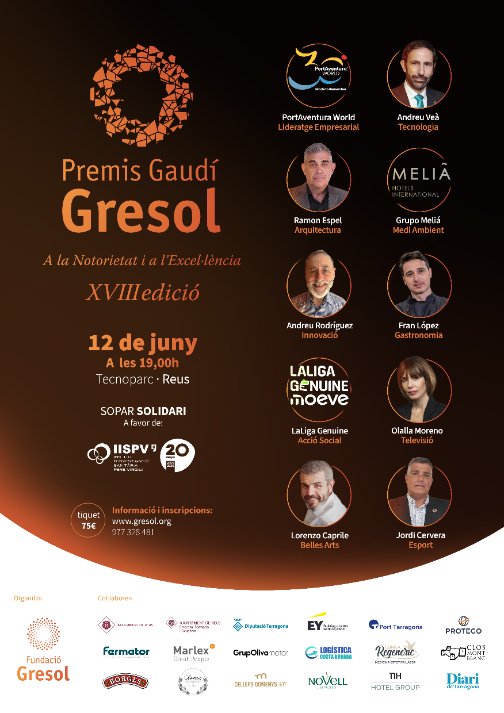
The lnstitut d’Investigació Sanitària Pere Virgili (IISPV) will be the beneficiary of the Premis Gaudí Gresol a la Notorietat i l’Excel·lència this year 2025, coinciding with 20 years of work in the field of biomedical research. The competition, which celebrates its 18th edition this year, will award the prizes on June 12 (7 p.m.) at the Gaudí auditorium of the firaReus complex.
The awards presentation ceremony, held on Wednesday, June 4 at the Ajuntament de Reus, was attended by the president of the Gresol Foundation, Emili Correig, the mayor of Reus, Sandra Guaita, the councilman of Empresa, Formació i Ocupació, Òscar Subirats and the general director of the Gresol Foundation, Robert Moragues.
The awards highlight the professional and personal careers, merits, worth and dedication of renowned entities and personalities, both in Catalonia and throughout Spain. The winners in this 18th edition are: in the category of Business Leadership, PortAventura World; in Technology, Andreu Veà; in Architecture, Ramon Espel; in Environment, Grupo Meliá; in Innovation, Andreu Rodríguez; in Gastronomy, Fran López; in Social Action, LaLiga Genuine; in Television, Olalla Moreno; in Fine Arts, Lorenzo Caprile; and, in Sports, Jordi Cervera.
Among the winners in past editions, there are personalities such as Pau Gasol, Valentí Fuster, Luis del Olmo, Ferran Adrià, Juan A. Samaranch, Isidre Fainé, Carles Sentís, Eduard Punset, Antoni Brufau, Mercè Sampietro, Joan Roca, Carme Ruscalleda, Anna Ferrer, Maribel Verdú, Elena Arzak, Josep M. Pou, Marc Márquez, Jordi Cruz, Gemma Mengual, Joan Pera, Manel Fuentes, Josep M. Mainat, M. De la Pau Janer, María Blasco, Jordi Basté, Marina Rossell, Tricicle, Susanna Griso or Juan Carlos Unzué among others.