
A study led by the IRB CatSud and the HUIPM reviews 122 papers on compounds such as vitamin D3 and magnesium across a range of psychiatric disorders
Psychiatric disorders such as schizophrenia, bipolar disorder, major depression, and autism spectrum disorder (ASD) have been linked in recent years to mitochondrial dysfunction—a loss of cellular capacity to produce the energy required for proper functioning. Now, a team from the Institut de Recerca Biomèdica Catalunya Sud (IRB CatSud) and the Hospital Universitari Institut Pere Mata (HUIPM) has led a systematic review on the use of nutraceutical supplements (such as vitamin D3, coenzyme Q10, magnesium, and various B vitamins), which are essential for mitochondrial function, as an adjunctive treatment for these psychiatric conditions.
Considering that the brain consumes approximately 20% of the body’s energy, largely produced within the mitochondria, the research team evaluated whether supplementation targeting this biological pathway could yield clinical benefits. To this end, the researchers reviewed articles published between January 2007 and April 2024. From an initial pool of 2,061 identified records, 122 studies meeting the inclusion criteria were ultimately evaluated.
Among the supplements analyzed, vitamin D3 emerged as the most widely researched across these pathologies. While trials on depression prevention failed to demonstrate an overall effect, individual studies noted improvements in specific subgroups, such as individuals with moderate-to-severe depression or those in the perinatal period. N-acetylcysteine showed more consistent findings across several schizophrenia studies, particularly regarding global symptoms and cognitive functions. The research team emphasizes that: “The findings of this review indicate that certain nutraceuticals could hold a promising role as an adjunctive therapy in psychiatry. However, more robust clinical trials with standardized protocols and validated efficacy biomarkers are required before translating this evidence into clinical practice,” explains Juan Tortajada, lead author of the study and member of the Genetics and Environment in Psychiatry (GAP) group at HUIPM-IRB CatSud-URV.
The authors also highlight the necessity of integrating socioeconomic factors, such as educational attainment and income levels, into future research. These variables can influence access to, adherence with, and continuity of nutraceutical regimens, making them key considerations for designing inclusive strategies in psychiatric care.
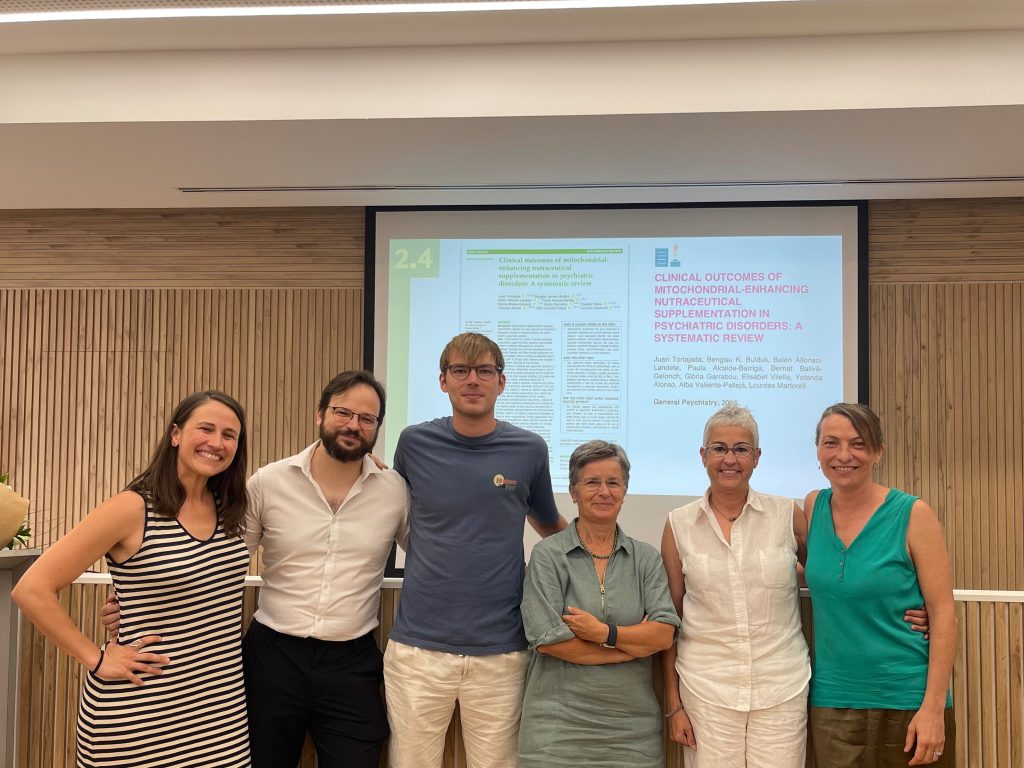
The study, led by Lourdes Martorell with Juan Tortajada and Bengisu Kevser Bulduk as co-first authors, has been published in the journal General Psychiatry. The research was conducted within the framework of an interCIBER collaboration, involving the Biomedical Research Networking Center in Mental Health (CIBERSAM) and the Biomedical Research Networking Center on Rare Diseases (CIBERER). This joint effort enabled the integration of expertise in mental health with specialized knowledge in mitochondrial pathology. Glòria Garrabou (IDIBAPS, UB, HCB, CIBERER), a co-author who contributed a translational perspective, notes that “this work could ultimately contribute to the development of novel therapeutic approaches for mental disorders that combine conventional pharmacology with nutritional supplementation
Bibliographical reference: Tortajada, J., Bulduk, B. K., Alfonso-Landete, B., Alcaide-Barriga, P., Ballvé-Gelonch, B., Garrabou, G., Vilella, E., Alonso, Y., Valiente-Pallejà, A., & Martorell, L. (2026). Clinical outcomes of mitochondrial-enhancing nutraceutical supplementation in psychiatric disorders: A systematic review. General psychiatry, 39(3), e70023. https://doi.org/10.1002/gps3.70023
The study was funded by the Instituto de Salud Carlos III and the Agència de Gestió d’Ajuts Universitaris i de Recerca (AGAUR) of the Generalitat de Catalunya.
 Facebook
  Mail
Mail  WhatsApp